Support the Monkey! Tell All your Friends and Teachers

Help / FAQ


Win a $1000 or more Scholarship to college!


Please Take our User Survey

  1. If in an equation of nth degree, the term with xn is absent, then the coefficient of the next higher power of x when equated to zero, gives horizontal asymptotes (provided it must not be a constant)

    For example, x3 + 3xy2 + y2 + 2x + y = 0 has no horizontal asymptote as x3 is present

    For example x2 y3 + x33y2 = x3 + y3

    This equation is a 5th degree equation. Since x5 is absent, we have coefficient of x3 is (y2 - 1)= 0 i.e. y = ± 1 are two asymptotes parallel to x-axis i.e. horizontal asymptotes.

    Note that the ‘Oblique asymptotes’ concept is beyond the scope of this book.

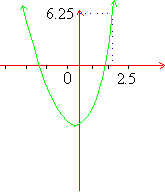
Example 1 Sketch the graph of the function x2 + 2x - 5 (1) using it determine the real roots of x2 + 2x - 5 = 0 (2) Find y when x = 2.5

Solution :

1) Let y = f(x) = x2 + 2x - 5

x

- 4

-3

-2

-1

0

1

2

3

y = f(x)

3

-2

-5

-6

-5

-2

3

10

The curve is a parabola which cuts x-axis in points whose abscissa is between 1 and 2 and a point whose abscissa is between -3 and 4. From the graph the roots are x =1.5 and x = -3.5. From the graph y = 6.25 when x = 2.5.


[next page]


Index

Introduction

1.1 Functions And Mapping
1.2 Functions, Their Graphs and Classification
1.3 Rules for Drawing the Graph of a Curve
1.4 Classification of Functions
1.5 Standard Forms for the equation of a straight line
1.6 Circular Function and Trigonometry

Chapter 2

All Contents Copyright © All rights reserved.
Further Distribution Is Strictly Prohibited.

793 PinkMonkey users are on the site and studying right now.