|
11. 11 The Budget
Throughout Eisenhower’s 2 terms, there was a constant
battle between the President and the Democrats in the Congress over
the budget. The question was how much to spend ? In the financial
year ending June 1959, the budget deficit was $12,400,000,000 due
to heavy defense expenditure. So when the President proposed a budget
of $77,000,000,000 for the financial year ending June 1960, the
northern Democrats attacked it. The Democrats felt that the amount
wasn’t enough to provide services to the country or to encourage
the economy. The President defended his stand on the Budget and
finally won. The government ended the 1960 financial year with a
surplus of $1,000,000,000.
The debate on the budget went on creating quite
a controversy. This issue and other foreign policy issues became
the main topics of debate during the elections of 1960. The 1960,
elections, saw John F. Kennedy running as the Democratic candidate
for the Presidential past. He won the elections by a very tiny margin.
When President John F. Kennedy took the oath of office, in January
1961, he stated in his inaugural speech. "Let the word go forth
from this time and place, to friend and foe alike, that the touch
has been passed to a new generation of Americans ..." During
the first few weeks of Kennedy’s administration, he sent several
messages to the Congress. Chief among them were his plans for large
scale programs to eradicate unemployment; care for old people; provide
assistance to schools; conserve nature and natural resources, etc.
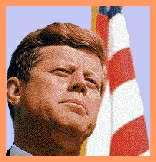
Exhibit 11.3
President John F. Kennedy
Like Eisenhower, Kennedy was also interested in
checking excessive expenditures in the budget. However, 2 problems
i.e. a mild recession and the communist threat abroad made it necessary
to increase the expenditure especially, defense. The chief legislations
passed during Kennedy’s Tenure were:
The Housing Act (1961) - It provided a total
of $4,900,000,000 over a period of 4 years in the form of government
loans and grants to develop middle income houses and local transit
systems and to preserve green spaces in the cities.
An improved Minimum Wages law - Provided
for a gradual increase of the minimum wages from $1.00 per hour
to $1.25 per hour. Also, it brought over 3 million additional workers
under its coverage. A higher social security benefit was provided,
as per the President’s recommendations.
[Next Page]
|
Table of Contents
11.0
- Chronology of Major Events in this Period
11.1 - Conditions at Home
11.2 - The Employment Act
11.3 - The Taft-Hartley Labor Management
Relations Act
11.4 - The Truman's Civil
Rights Program
11.5 - The McCarthy Period
11.6 - The Cold War Abroad
11.7 - The Korean War
11.8 - The Eisenhower Administration
11.9 - The Civil Rights movement
and the question of Desegregation
11.10 - The Labor Reform act
11.11 - The Budget
11.12 - The Economy in
the 60s
11.13 - The Communist Threat
Abroad
11.14 - The Threat of Nuclear
War
11.15 - The Exploration of
Outer Space
11.16 - The Geneve Conference
on Disarmament
11.17 - Our WorldToday
|